LESCO Meter Reading Date – How to Understand Your Billing Cycle
Understanding your LESCO Meter Reading Date can help you monitor electricity consumption, check your monthly bill, and identify possible billing errors. Many consumers only look at the total amount due, but the reading date is equally important because it shows when the electricity meter reading was recorded for that billing period.
If your bill seems higher than usual or the number of units does not match your expectations, checking the meter reading date and comparing the previous and present readings can help you understand what happened.
This guide explains how to find your LESCO meter reading date, understand your billing cycle, calculate units consumed, and take action if you notice an incorrect reading.
What Is the LESCO Meter Reading Date?
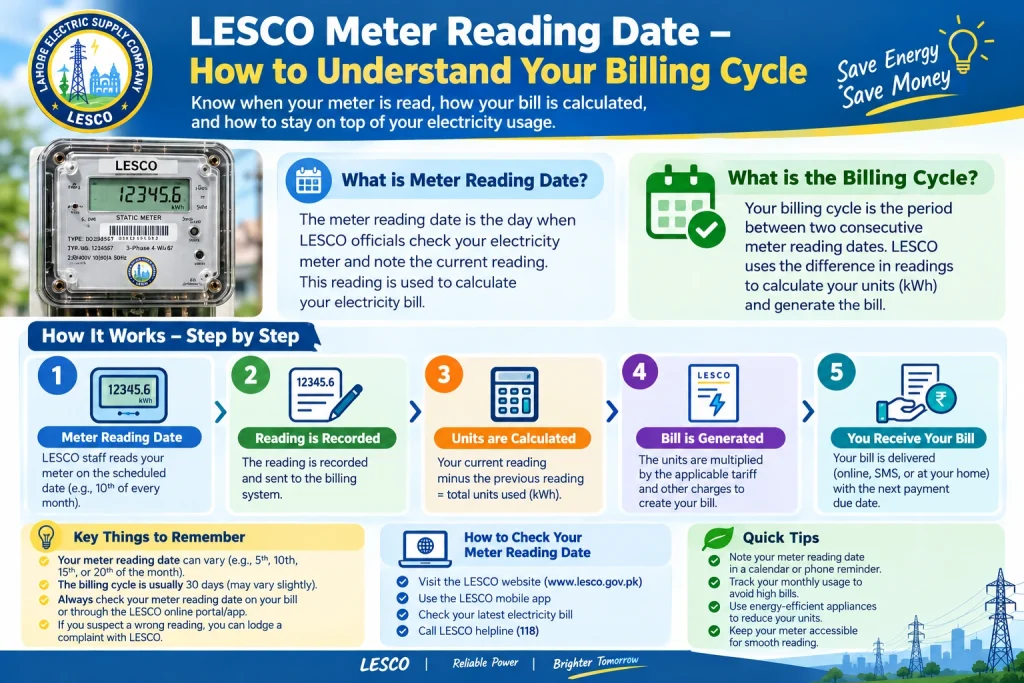
The LESCO Meter Reading Date is the date on which your electricity meter reading is recorded for billing purposes. LESCO uses meter readings to calculate the electricity consumed during a particular billing period.
For example, if your previous reading was recorded on May 15 and the next reading was recorded on June 14, your bill generally reflects consumption measured between those reading dates.
Meter readings are usually taken monthly. However, the exact date can vary depending on your area, meter-reading schedule, and assigned billing batch. Therefore, you should check the date printed on your own electricity bill instead of assuming that every consumer has the same schedule.
How to Check Your LESCO Meter Reading Date
You can usually find your reading date directly on your electricity bill. Follow these steps to check it:
- Get your latest LESCO bill: Use your printed electricity bill or open a digital copy.
- Find the billing details: Look for the section containing your billing month, meter readings, and important dates.
- Locate the reading date: Find the field labelled “Reading Date” or a similar label.
- Check the previous and present readings: These figures help you understand how many units were recorded during the billing period.
- Compare the dates: If you have an older bill, compare its reading date with the current one to see how the billing period has changed.
The exact position of these details may vary depending on the bill layout. If you cannot locate the information, use LESCO’s official website or contact the relevant customer service office for assistance.
Understanding the LESCO Billing Cycle
The billing cycle is the period for which your electricity consumption is measured and billed. LESCO generally records meter readings every month, and the readings are used to calculate the units consumed during the billing period.
Your billing cycle is not necessarily the same as a calendar month. For example, your consumption period might begin in the middle of one month and end in the middle of the next.
Understanding the billing cycle is useful because the number of days covered by a bill can affect the total units charged.
Important Dates on Your LESCO Bill
| Bill detail | What it means |
|---|---|
| Billing Month | The month for which the bill is issued |
| Reading Date | The date the meter reading was recorded |
| Previous Reading | The meter reading recorded during the previous cycle |
| Present Reading | The latest recorded meter reading |
| Issue Date | The date the electricity bill was issued |
| Due Date | The deadline for paying the bill under the stated payment terms |
Remember that the reading date, issue date, and due date serve different purposes. The reading date relates to electricity consumption, the issue date tells you when the bill was generated, and the due date tells you when payment is required.
How to Calculate Units Consumed on Your LESCO Bill
One of the easiest ways to understand your bill is to compare the previous meter reading with the present reading.
Formula:
Units Consumed = Present Reading − Previous Reading
For example, suppose your bill shows the following readings:
- Previous reading: 12,450
- Present reading: 12,720
- Total units consumed: 270
In this example, subtracting 12,450 from 12,720 gives 270 units.
This calculation helps you verify the recorded consumption. However, the final payable amount may also include taxes, applicable adjustments, fixed charges, arrears, or other bill components. Therefore, the number of units alone does not determine your total bill.
If your connection uses time-of-use metering or net metering, additional reading details may appear. Check the relevant fields separately rather than applying the basic calculation to every figure on the bill.
Why Can Your LESCO Meter Reading Date Change?
Your reading date may vary slightly from one month to another. This does not automatically mean that your bill is incorrect.
Common reasons include:
- Reading schedules: Different areas or consumer batches may have different scheduled dates.
- Public holidays or operational delays: Field schedules can sometimes change.
- Billing-period adjustments: The period covered by a bill may vary according to the recorded readings and billing arrangements.
- Meter access issues: If a meter cannot be accessed, the reading process may require further action.
- Meter problems: A defective or malfunctioning meter can affect how consumption is recorded or assessed.
If the reading date changes, compare the actual billing period and the previous and present readings before deciding that an error has occurred.
What to Do If Your LESCO Meter Reading Is Incorrect
If your bill shows more units than expected, compare the figures on your bill with the reading displayed on your physical electricity meter.
Follow these steps:
- Check the meter number on your bill to confirm that you are looking at the correct connection.
- Compare the present reading printed on your bill with the reading currently displayed on your meter.
- Check whether the previous reading and current reading have been entered correctly.
- Take a clear photograph of your meter display, preferably with the date recorded for your own reference.
- Keep a copy of your bill and note the difference between the displayed reading and the billed reading.
- Contact LESCO through its official complaint channels or visit the relevant customer service office if the discrepancy remains unexplained.
Keep in mind that your meter’s current reading may be higher than the reading printed on your latest bill because electricity continues to be consumed after the billing reading was taken. Compare the dates before concluding that the bill is wrong.
If your bill appears to use an estimated or average reading, ask LESCO to explain the calculation and the process for correcting it, if applicable.
How to Check Your LESCO Bill Online
Checking your bill online can help you review your billing details without waiting for a printed copy.
To check your bill:
- Open the official LESCO website or the authorised electricity bill service linked through it.
- Enter the required reference number or other requested account details.
- Open the available bill for your connection.
- Review the billing month, reading date, previous reading, present reading, units consumed, issue date, and due date.
- Save or print a copy for your records if the service provides that option.
Official website: https://www.lesco.gov.pk/
Always verify that you are using an official or authorised service before entering account information. If the latest bill is not available online, contact LESCO to confirm its status.
Frequently Asked Questions
1. Where can I find my LESCO Meter Reading Date?
You can usually find the date in the billing details section of your latest electricity bill. Look for the label “Reading Date” or a similar field.
2. Does LESCO take meter readings on the same date every month?
LESCO generally follows a monthly meter-reading schedule, but the exact date can vary by area or consumer batch. Check your bill for the date recorded for your connection.
3. Is the meter reading date the same as the bill issue date?
No. The reading date is when the meter reading is recorded, while the issue date is when the bill is generated. The due date is the deadline for payment.
4. Why are my electricity units higher this month?
Higher consumption, a longer billing period, changes in appliance use, or a reading or meter issue may explain the increase. Compare your previous and present readings and check the number of days covered by the bill.
5. Can I check my LESCO reading date online?
You can review the reading date if it is included in the digital bill available through an official or authorised bill-checking service. The information displayed may depend on the bill format and available records.
6. What should I do if my bill has an incorrect reading?
Compare the bill with your meter display, keep a photograph and a copy of the bill, and report the discrepancy through LESCO’s official complaint channels.
Conclusion
Knowing your LESCO Meter Reading Date makes it easier to understand your electricity billing cycle and verify the units charged each month. By checking the reading date, comparing previous and present readings, and reviewing the billing period, you can better understand why your bill amount changes.
If you notice an unexplained difference, keep the relevant evidence and contact LESCO for clarification. Regularly reviewing your electricity bills can help you identify possible errors early and manage your monthly electricity expenses more effectively.